
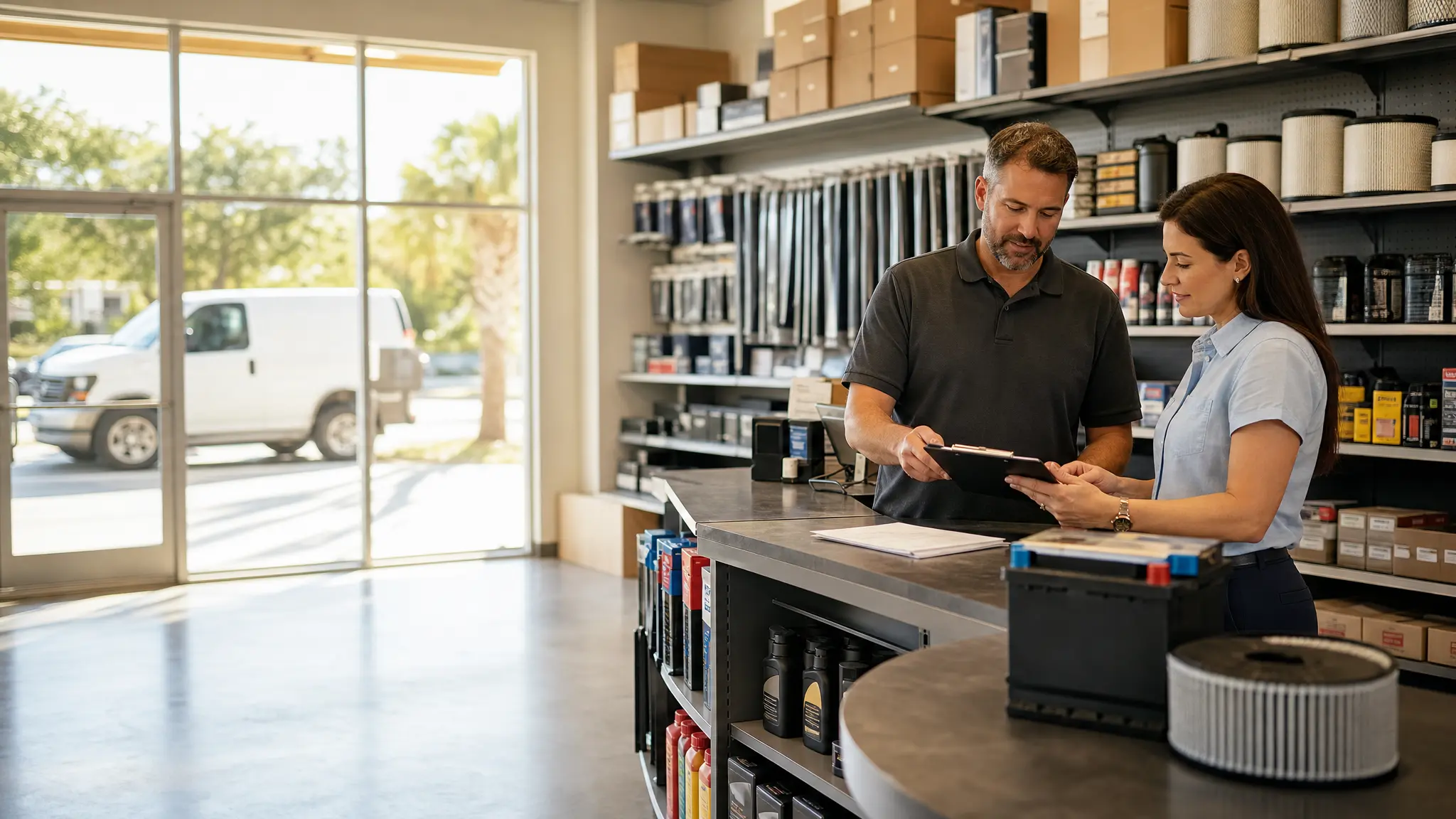
Auto Parts Store Insurance in Florida: Inventory, Delivery Vehicles, Customer Injuries, and Garage Exposure
Florida auto parts store insurance guide for BOP/property, inventory, customer injuries, product liability, delivery vehicles, workers comp, cyber/POS, and garage exposure.

Joe Greene
Licensed Insurance Agent
Auto parts store insurance in Florida is not the same as a generic retail shop policy. A parts store has customers walking aisles with heavy batteries and brake rotors, shelves full of inventory, delivery runs, POS and payment systems, employee lifting exposure, and sometimes a gray area between retail sales and garage operations.
That gray area matters. A store that only sells boxed parts is a different insurance account than a store that tests batteries, installs wipers, changes bulbs, diagnoses check-engine lights, jump-starts vehicles, delivers parts to repair shops, or keeps customer vehicles near the building.
Compare retail coverage on our Florida retail store insurance page. If the operation handles customer vehicles or performs repairs, also review Florida auto repair shop insurance. Auto parts stores may need retail coverage, inventory protection, delivery coverage, and garage protection when customer vehicles are involved.
Need an auto parts store insurance review? Send store details, inventory values, delivery vehicles, employee count, payroll, lease wording, current policies, and any installation or customer-vehicle services.
Florida Auto Parts Store Insurance Starts With the Real Operation
Florida auto parts store insurance starts with what the store actually does. Two stores with the same label may need different coverage and pricing when one installs parts, handles customer vehicles, or makes deliveries.
A retail-only parts business may focus on:
- New auto parts and accessories
- Batteries, fluids, filters, belts, bulbs, and wipers
- Customer foot traffic
- Point-of-sale payments
- Inventory and shelving
- Local delivery to commercial accounts
- No repair work and no customer-vehicle custody
The account becomes more complicated when the store also offers:
- Battery testing or battery installation
- Wiper blade installation
- Bulb installation
- Diagnostic code reading
- Jump-start assistance
- Roadside or parking-lot help
- Used or salvaged parts
- Delivery vehicles and employee drivers
- Customer vehicles moved, stored, or worked on
Parts-only retail and garage operations are not the same
Tell us if employees install parts, diagnose vehicles, drive customer cars, or keep customer vehicles on site. Those services can add garage liability, garagekeepers, or commercial auto coverage and change the current carrier choices.
BOP, Property, and Inventory Coverage for Auto Parts Stores
A business owner's policy or commercial package can often be the starting point for an auto parts store. The property side needs to reflect the store's real inventory, tenant improvements, shelving, signage, computers, POS equipment, and business income exposure.
Inventory is the part to slow down on. Auto parts stores can carry a mix of low-cost items and higher-value stock. Batteries, electronics, tools, specialty parts, performance accessories, and commercial-account inventory can change the policy limit conversation.
Review:
- Average inventory value
- Peak seasonal inventory
- Highest-value product categories
- Tools, scanners, lifts, compressors, or installation equipment
- Shelving, racking, tenant improvements, and signage
- Theft controls, cameras, alarms, and locked storage
- Business income and extra expense
- Wind, water, and storm-related property concerns
- Lease insurance requirements
Inventory limit problem
An auto parts store carries $175,000 in average inventory but pushes above $275,000 during a seasonal stocking period. If the property limit was set from a slow month, a fire, theft, or storm loss can expose the gap at the worst possible time.
For stores in leased space, the landlord's insurance requirements should be sent early. A lease can ask for specific general liability limits, property wording, waiver wording, additional insured status, or certificate handling.
Customer Injuries, Product Liability, and Completed-Operations Questions
General liability is the coverage most business owners think of first. It can respond to certain customer injury or property damage claims, subject to the policy. In an auto parts store, premises risk is practical: customers can trip near displays, drop heavy items, slip near fluids, or get hurt while loading parts.
Product liability exposure also needs review. The store may sell parts it did not manufacture, but customers and attorneys may still name the seller after an accident, installation issue, or alleged product failure. The policy form, product category, suppliers, warranties, and loss history all matter.
Ask about:
- Batteries, fluids, chemicals, and cleaners
- High-performance or specialty parts
- Used, remanufactured, or salvaged parts
- Private-label products
- Online sales or shipping
- Installation advice or verbal recommendations
- Written warranties or return policies
Key Takeaway
An auto parts store insurance review should separate three questions: people getting hurt in the store, products allegedly causing damage after sale, and employees performing services on or around customer vehicles.
Delivery Vehicles and Hired or Non-Owned Auto
Delivery vehicles can turn a retail account into a commercial auto account. If the store owns vans, pickups, or cars for parts delivery, those vehicles need to be reviewed under commercial auto insurance, not treated as an afterthought.
The Florida Department of Highway Safety and Motor Vehicles says vehicles with a current Florida registration must carry PIP and property damage liability coverage, with minimums of $10,000 PIP and $10,000 PDL for ordinary registered vehicles. Those registration minimums are not the same as the limits a business should choose for delivery, contracts, financed vehicles, umbrella fit, or serious accident exposure.
Delivery review should include:
- Vehicle schedule, VINs, values, and garaging
- Driver list and MVR concerns
- Radius of delivery
- Retail delivery vs wholesale delivery to repair shops
- Employee use of personal vehicles
- Rented or borrowed vehicles
- Hired and non-owned auto
- Physical damage for owned vehicles
- Contract or vendor auto-limit requirements
Employee personal vehicles can still create business exposure
If an employee uses a personal vehicle to deliver parts, pick up inventory, or run a business errand, the business can still be pulled into an accident claim. Hired and non-owned auto should be reviewed instead of assuming the employee's personal policy solves it.
For stores with several vehicles or regular drivers, use the Florida fleet insurance guide to organize vehicle schedules, driver lists, loss runs, garaging, and contract requirements.
When Auto Parts Stores Cross Into Garage Liability or Garagekeepers
The biggest insurance mistake is pretending all auto parts stores are parts-only retailers. Some are. Some are not.
Garage exposure can appear when staff:
- Install batteries, wipers, bulbs, or accessories
- Test batteries or electrical systems
- Diagnose vehicle codes
- Jump-start vehicles
- Move customer vehicles
- Keep customer vehicles on site
- Perform light repair or mobile help
- Store customer keys
- Service commercial fleet customers
Garage liability and garagekeepers coverage are different. Garage liability generally addresses certain third-party injury or property damage tied to garage operations, while garagekeepers focuses on customer vehicles in the business's care, custody, or control. The wording, limit, deductible, and legal liability or direct coverage treatment should be checked.
Pro Tip
If the store touches customer vehicles, say so before quoting. Hiding installation or diagnostic work to force a retail quote can create a coverage fight later.
For stores with meaningful vehicle work, the better starting path may be auto repair shop insurance, quick lube insurance, tire shop insurance, or detail shop insurance, depending on the actual operation.
Workers Comp, Employee Theft, and Cyber/POS Risk
Workers compensation should be reviewed when an auto parts store has employees, warehouse work, delivery drivers, installers, or stockroom handling. The Florida CFO workers compensation guidance says non-construction employers with four or more employees, including certain business owners, corporate officers, or LLC members, must have workers compensation coverage.
Employee count is not the only practical question. Auto parts stores can have lifting injuries, slips, ladder or stockroom injuries, cuts, battery handling, delivery accidents, and repetitive-motion issues. Payroll, job duties, owners/officers, and classification should be reviewed carefully.
Also review:
- Crime or employee theft coverage
- Money and securities
- Inventory shrinkage controls
- Cyber liability for POS systems
- Payment card and vendor account access
- Email compromise and invoice fraud
- Customer data and loyalty programs
Cyber is not just a tech-company problem. A store that accepts cards, stores customer account information, uses online ordering, or has commercial-account billing can face breach response, business interruption, and fraud costs.
What to Send Before an Auto Parts Store Insurance Quote
A faster comparison starts with a clear description of the store. Tell us about delivery vehicles, battery installation, diagnostics, and customer-vehicle handling at the start so we can compare the right coverage and prices.
Send:
- Current policies and declarations pages
- Store address and lease insurance requirements
- Annual sales and payroll
- Employee count and owner/officer details
- Inventory values and highest seasonal stock
- Product categories and high-value stock
- Used, remanufactured, performance, or private-label products
- Delivery vehicles, driver list, and delivery radius
- Employee personal-vehicle use
- Installation, diagnostic, jump-start, or parking-lot services
- Customer-vehicle storage or key-handling details
- POS/cyber controls and online sales details
- Prior claims and loss runs
- Renewal, lease, lender, or certificate deadlines
Ready to review a Florida auto parts store? Upload current policies, inventory values, payroll, employee count, vehicle details, lease wording, and any installation or customer-vehicle services.
Compare Related Auto Parts Store Coverage
Use the retail page for the full store quote, commercial auto for delivery vehicles, and auto-repair coverage when employees work on customer vehicles.
- Florida retail store insurance
- Business owner's policy
- Commercial property insurance
- General liability insurance
- Commercial auto insurance
- Workers compensation insurance
- Cyber liability insurance
- Auto repair shop insurance
Florida Auto Parts Store Insurance FAQ
Florida auto parts store insurance FAQs should make the retail-vs-garage line clear before the quote starts. Inventory, product liability, deliveries, workers comp, cyber/POS, and customer-vehicle handling do not all belong in the same bucket.
Quick answers for parts stores comparing retail BOP coverage, inventory, deliveries, workers comp, cyber/POS, and garage exposure.
What insurance should a Florida auto parts store review?
Most Florida auto parts stores should review general liability, commercial property or BOP coverage, inventory limits, product liability exposure, business income, workers compensation, cyber or POS risk, crime or employee theft, commercial auto for deliveries, and garage liability or garagekeepers coverage if staff handle customer vehicles.
Can an auto parts store use a standard retail BOP?
A retail BOP may fit a parts-only store with straightforward inventory, customer foot traffic, and no vehicle work, but it should be reviewed carefully. Delivery, battery installation, wiper installation, diagnostics, test drives, used parts, fluids, and customer-vehicle handling can push the account beyond a simple retail package.
Does an auto parts store need garage liability insurance?
A parts-only retailer may not need garage liability, but the question changes when employees install parts, test batteries, diagnose vehicles, jump-start cars, move customer vehicles, or keep customer vehicles on site. Those operations should be reviewed against auto repair or garage coverage.
When does a Florida auto parts store need workers comp?
Florida CFO guidance says non-construction employers generally need workers compensation when they have four or more employees, including certain business owners, corporate officers, or LLC members. Employee count, ownership structure, payroll, delivery drivers, and warehouse work should be reviewed.
What should I send for an auto parts store insurance quote?
Send current policies, store address, annual sales, payroll, employee count, inventory values, highest seasonal stock, delivery vehicle details, driver list, POS/cyber controls, lease requirements, product categories, installation or diagnostic services, customer-vehicle handling, prior claims, and loss runs if available.
Need help comparing insurance for retail, garage, delivery, or a mix of all three? Contact Greene & Associates before the renewal or lease deadline.

Commercial Insurance Team Leader
Joe Greene began his Florida insurance career in 2004 and holds an active Florida 2-20 General Lines license. He leads commercial insurance work at Greene & Associates, with depth in commercial property, fleets, contractors, workers compensation, general liability, habitational risks, and contract requirements. FL License #P005559.
joe@greeneinsurance.comReady to Get Covered?
Send the lease, current policies, property values, certificate wording, and renewal date so our office can compare BOP, package, or separate GL and property options.