
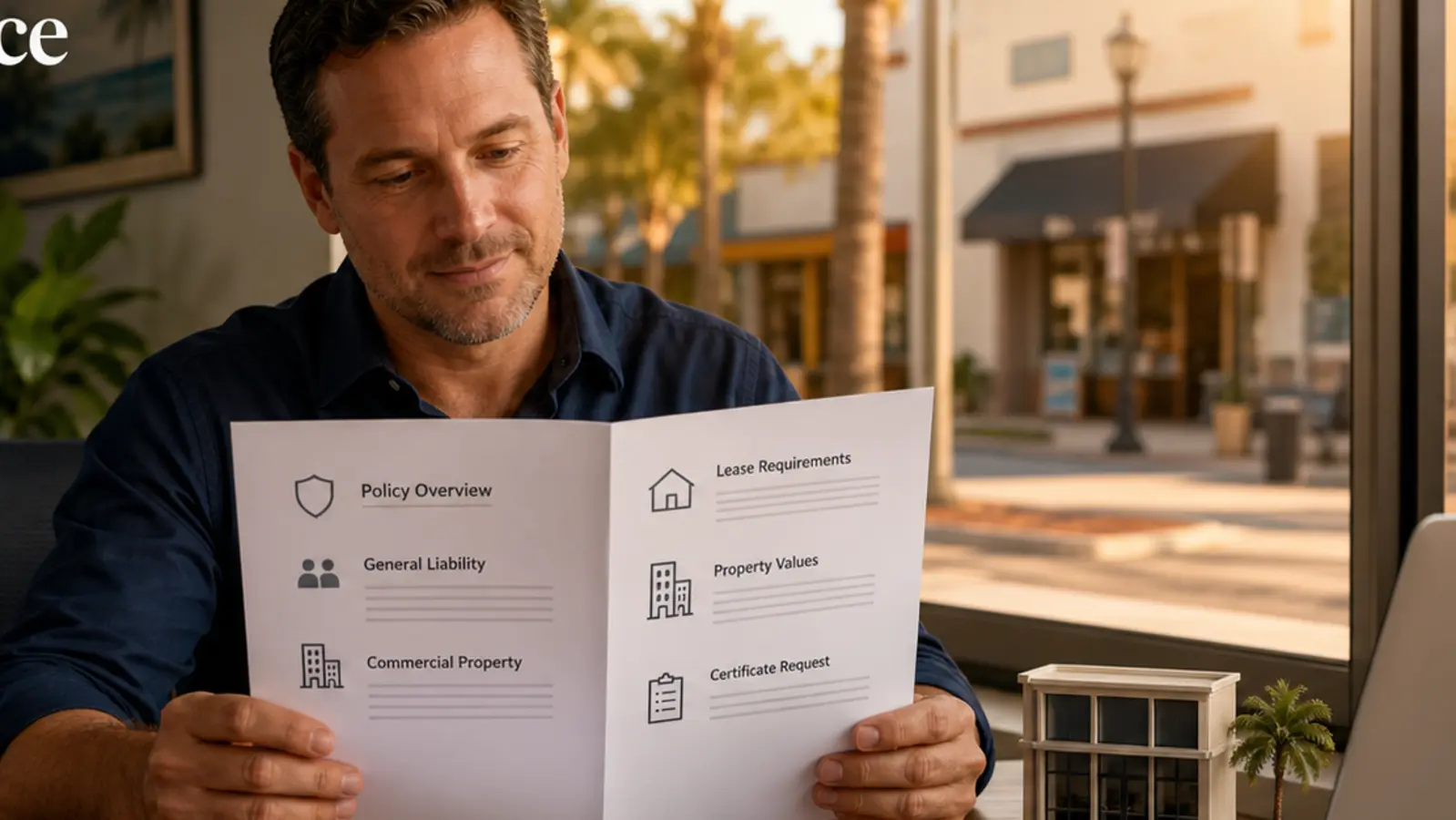
Florida Business Insurance When You Need General Liability and Commercial Property
Florida business insurance options when one agency coordinates general liability and commercial property: BOP, package policy, separate policies, and quote prep.

Joe Greene
Licensed Insurance Agent
If a Florida business needs both general liability insurance and commercial property insurance under one agency, the usual options are a Business Owners Policy, a commercial package policy, or separate general liability and property policies coordinated through the same independent agency.
The best setup depends on the lease, lender, certificate request, building value, wind deductible, flood exposure, and current carrier choices.
This guide explains what options are available, when a BOP is enough, when separate policies make more sense, and what to send so our office can compare coverage and prices.
Need general liability and commercial property together? Send the lease, current policy, property values, certificate wording, and renewal date so our office can compare BOP, package, and separate-policy prices.
Short Answer: Florida Businesses Usually Compare a BOP, Package Policy, or Separate GL and Property Policies
A Florida business that needs general liability and commercial property insurance usually starts with one of three structures:
- Business Owners Policy (BOP) - a package option for eligible smaller or straightforward businesses that can include general liability, commercial property, and business income coverage.
- Commercial package policy - a more flexible package structure for businesses that still want coordinated coverage but do not fit a simple BOP.
- Separate general liability and commercial property policies - a better option when the business, building, lease, limits, wind exposure, or available carrier terms call for separate policies.
We compare a bundled policy, commercial package, and separate policy setup so the business can see which coverage and price work best together.
Compare Florida business insurance, general liability insurance, commercial property insurance, and Business Owners Policy coverage.
Key Takeaway
- A BOP can be a strong starting point for smaller or straightforward businesses.
- Separate GL and property policies may be better for higher-value property, harder operations, contract limits, wind concerns, or multiple locations.
- One agency can coordinate the quote even when the final answer uses more than one policy.
- Flood, workers comp, commercial auto, cyber, professional liability, and umbrella coverage may still need separate review.
When a Business Owners Policy Can Bundle GL and Commercial Property
A Business Owners Policy can work when the business has a relatively straightforward operation, manageable property values, occupancy, claims history, and limits that fit a carrier's BOP program.
For many Florida retailers, offices, restaurants, service businesses, and smaller owner-operated businesses, a BOP is the first coverage option to check because it can put the two core pieces together:
- General liability for certain third-party bodily injury, property damage, premises, and operations claims, subject to policy terms.
- Commercial property for covered damage to business personal property, inventory, tenant improvements, or the building if the business owns it.
- Business income or business interruption coverage when a covered property loss shuts down or slows down operations.
The available BOP options depend on the business type, building, roof, contents values, tenant mix, prior losses, and operations. If a BOP is not available, our office can compare a commercial package or separate GL and property policies.
Good BOP Candidates in Florida
A BOP may be worth checking when the business has:
- One or a few locations
- Clear operations and no unusual hazard
- Retail, office, professional, food service, or service-business exposure
- Reasonable business personal property or tenant improvement values
- A lease that asks for standard GL and property evidence
- No major product, vehicle, professional, or high-hazard contracting exposure
When a BOP Can Become Too Small
A BOP can become the wrong fit when the property exposure is too large, the business type is excluded, the lease or contract requires higher limits or special wording, or the building details need a separate property policy.
That does not mean the business cannot be insured. It means the quote needs to move from "simple bundle" to a more specific structure.
If your lease asks for GL, property, business income, waiver wording, additional insured status, or a certificate, send it with the current policy. We can compare BOP and separate-policy prices.
When Separate General Liability and Commercial Property Policies Make More Sense
Separate general liability and commercial property policies can make more sense when the risk does not fit neatly into a BOP.
This is common when the property side needs more flexibility. The Florida Department of Financial Services explains commercial property insurance as coverage for commercial buildings and contents, with policies varying by terms, conditions, and exclusions. Building details, values, roof, occupancy, wind exposure, protection, and loss history all affect the available options and price.
Separate policies may be the better route when the business has:
- Higher building, contents, inventory, equipment, or tenant improvement values
- Older roof information that needs explanation or inspection records
- Wind or named-storm deductible questions
- Flood exposure that needs separate NFIP or private flood review
- Multiple locations or changing occupancy
- A landlord or lender asking for specific property evidence
- A contract requiring GL limits or endorsements outside a basic BOP
- Operations that create product, completed-operations, garage, contractor, professional, or auto exposure
This is where an independent agency helps. Our office can compare a BOP, commercial package, standalone commercial property policy, standalone GL policy, or a combination and show you the available coverage and prices.
Commercial Property Is Not the Same as Liability
General liability and commercial property solve different problems.
General liability is mainly about claims from other people or organizations. Think customer injury, property damage to someone else, certain completed-operations claims, lease-related premises requirements, or certificate requests.
Commercial property is about the business's physical assets. Think building, business personal property, inventory, equipment, tenant improvements, business income, loss of rents, and sometimes equipment breakdown or ordinance or law endorsements.
That difference shows up fast after a loss.
If a customer slips in your store, that is a liability question. If a fire damages your inventory, shelving, and point-of-sale system, that is a property question. If floodwater rises into the building, that is usually a separate flood question. FEMA notes that flood insurance is a separate policy and can cover buildings, contents, or both for homes and businesses.
The Easy Mistake: Thinking GL Covers Your Stuff
A common mistake is assuming general liability protects tools, inventory, equipment, tenant improvements, or building contents. It usually does not.
A lower-priced GL-only quote may satisfy the liability requirement. If the business also owns inventory, equipment, or tenant improvements, compare property and business-income coverage at the same time.
Florida Questions That Change the GL and Property Coverage Choice
Florida makes the property side more complicated than a generic national article makes it sound.
Before choosing a BOP, package policy, or separate policy setup, review these questions:
Does the lease require property coverage or only liability?
Some leases ask only for general liability and additional insured wording. Others also require tenant improvements, plate glass, property, business income, waiver of subrogation, or specific certificate wording.
Do not guess. Send the lease insurance section before buying coverage.
Does the business own the building or lease the space?
An owner-occupied building, leased storefront, shopping-center tenant, warehouse tenant, and landlord-owned building each need different property details and coverage.
If you own the building, the building limit and valuation matter. If you lease, the tenant improvements, business personal property, inventory, and lease requirements may be the bigger issue.
Are wind and flood being handled correctly?
Wind may be included, excluded, limited, or subject to a percentage deductible depending on the policy and carrier. Flood is usually handled separately from standard commercial property.
For businesses near coastal areas, rivers, drainage issues, low-lying lots, or lender requirements, flood review should not be an afterthought.
Are workers comp, commercial auto, cyber, or umbrella also needed?
A BOP or GL/property setup does not replace every business policy.
Florida workers compensation rules can apply based on employee count, construction status, corporate officers, LLC members, and exemptions. The Florida CFO's workers compensation employer guidance is the better source for threshold questions than a generic quote page.
Commercial auto, hired and non-owned auto, cyber, professional liability, liquor liability, employment practices, crime, inland marine, equipment breakdown, and umbrella coverage may also need review depending on the business.
Want to compare business insurance prices before renewal? Send current policies, lease wording, payroll, sales, property values, roof/building details, vehicle schedule if any, loss runs, and certificate requests.
What to Send When You Need GL and Commercial Property Under One Agency
Accurate business and property details help our office compare real options faster.
Send these items if you have them:
- Current general liability, BOP, or commercial package declarations
- Current commercial property declarations
- Lease insurance requirements or landlord certificate instructions
- Lender requirements if the business owns the building
- Business name, address, entity type, and years in business
- Description of operations, services, products, and any subcontracted work
- Annual sales and payroll
- Employee count and owner/officer details
- Building ownership status: owned, leased, or landlord-owned
- Business personal property, inventory, equipment, and tenant improvement values
- Building limit, square footage, construction, roof age, updates, and protection details if owned
- Prior claims and loss runs when available
- Renewal date and certificate deadline
For property-heavy accounts, also review our Florida commercial property document checklist and statement of values guide.
Compare the Coverage Paths Before You Buy
If you are still sorting out which policy structure fits, these related guides can help narrow the coverage choice before you request prices:
- General liability insurance if the immediate concern is customer injury, third-party property damage, completed operations, or certificate wording.
- Commercial property insurance if the bigger question is building value, business personal property, inventory, equipment, wind, flood, or business income.
- Business Owners Policy if you want to see whether GL and property can be packaged together.
- BOP vs. separate policies in Florida if you are deciding between a bundled policy, a package, or separate GL and property coverage.
- Business insurance coverage and quotes if you want help choosing the right place to start.
Bottom Line for Florida Businesses Comparing GL and Commercial Property
If your company needs general liability and commercial property, start with a coordinated review rather than buying the first single-policy offer that appears online.
A BOP may be the most practical answer. A commercial package may be better. Separate GL and property policies may be necessary. Flood, workers comp, auto, cyber, umbrella, and professional liability may still need their own review.
Our office can help sort the structure before the renewal deadline, lease certificate request, or lender requirement forces a rushed decision.
Need one agency to compare general liability, commercial property, lease requirements, coverage, and prices together? Send the current policy and requirements so our office can compare the right structure.
Sources Used for This Florida Business Insurance Guide
These public resources explain property, flood, and workers compensation basics. Actual coverage and prices depend on the policy forms, business details, leases, lender requirements, and contracts.
- Florida DFS commercial property overview
- FEMA Flood Map Service Center
- NFIP commercial flood coverage summary
- Florida CFO workers compensation coverage requirements
- SBA guide to getting business insurance
Florida GL and Commercial Property Insurance FAQs
These quick answers are built for business owners comparing a BOP, commercial package policy, separate general liability policy, and commercial property quote.
What business insurance options are available in Florida if I need general liability and commercial property?
Many Florida businesses start by comparing a Business Owners Policy, commercial package, and separate general liability and property policies. A BOP can bundle general liability, commercial property, and business income coverage, while separate policies can offer more flexibility for larger property values, contracts, coastal wind, flood questions, or more complicated leases.
Can one agency handle both general liability and commercial property insurance?
Yes. One independent agency can coordinate general liability, commercial property, business income, lease certificates, lender requirements, and renewal pricing even when the best option uses more than one policy or carrier.
Is a BOP the same as commercial property insurance?
No. A BOP is a package policy for eligible businesses. It commonly includes general liability and commercial property coverage, and it may include business income coverage. A standalone commercial property policy focuses on building, contents, business personal property, business income, and related property exposures.
When should a Florida business use separate GL and commercial property policies instead of a BOP?
Separate policies may be better when the business has higher building or contents values, difficult occupancy, coastal wind exposure, older roof concerns, heavy tenant improvements, multiple locations, contract limit requirements, product or completed-operations concerns, or coverage needs that do not fit a standard BOP.
What should I send for a GL and commercial property quote?
Send the lease, current policies, certificate requirements, business address, operations description, sales, payroll, building or tenant improvement values, business personal property and inventory values, roof and building details if available, loss runs, lender requirements, and renewal date.

Commercial Insurance Team Leader
Joe Greene began his Florida insurance career in 2004 and holds an active Florida 2-20 General Lines license. He leads commercial insurance work at Greene & Associates, with depth in commercial property, fleets, contractors, workers compensation, general liability, habitational risks, and contract requirements. FL License #P005559.
joe@greeneinsurance.comReady to Get Covered?
Send the lease, current policies, property values, certificate wording, and renewal date so our office can compare BOP, package, or separate GL and property options.