
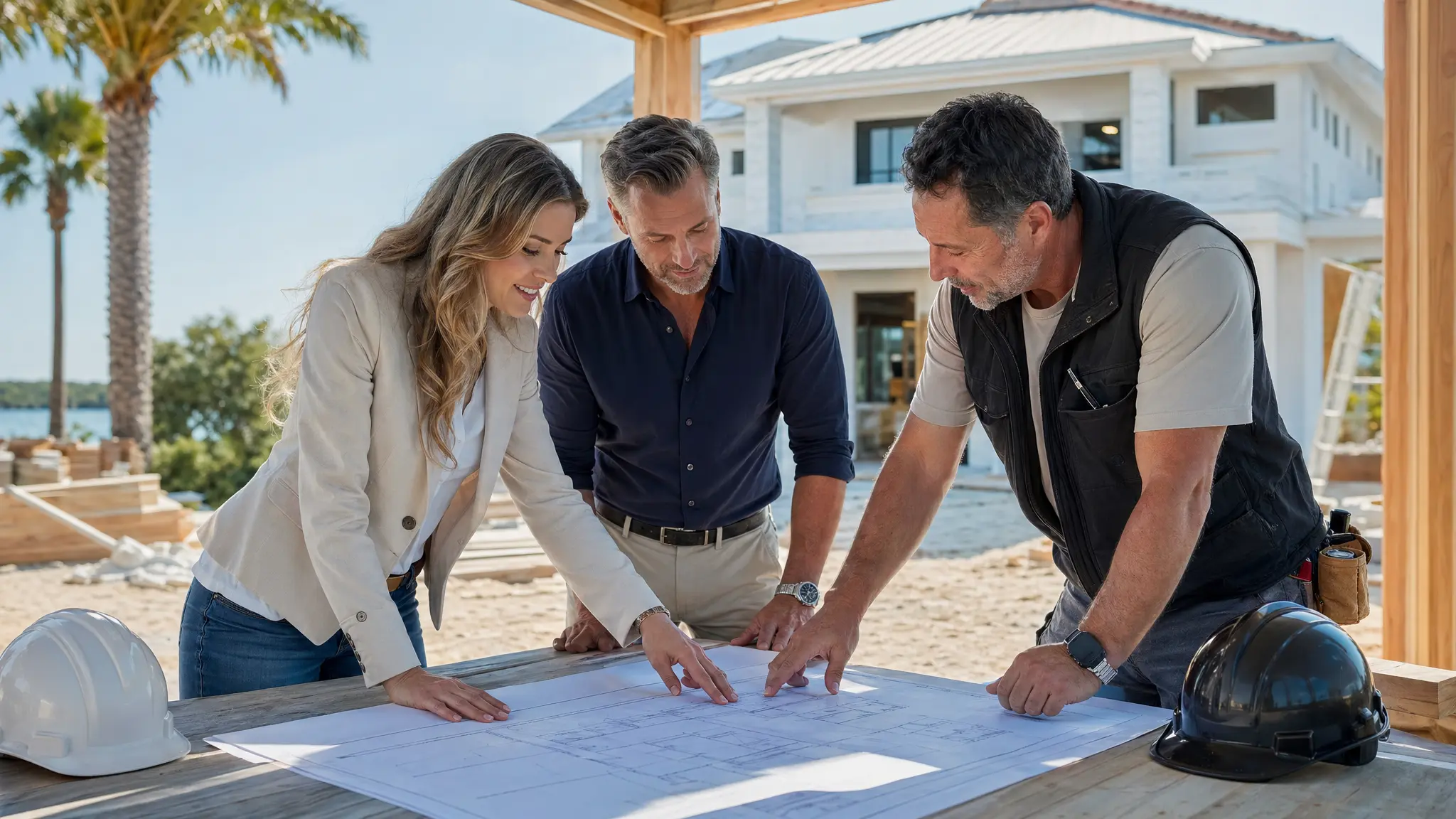
Builders Risk vs Homeowners Insurance While Building in Florida
Builder’s risk is temporary course-of-construction property coverage. Our new construction homeowners option is different: when underwriting allows, it can protect the build phase and transition into standard HO3 homeowners coverage after completion. For Florida owner-buyers, that can mean a simpler structure than defaulting to standalone builder’s risk.
Builder’s Risk vs New Construction Home Insurance: Fast Answer
- Traditional builder’s risk is often a temporary course-of-construction policy, while the HO3 DUC path is a homeowners policy with a construction endorsement.
- The construction-to-completion path can help avoid the separate-policy handoff after certificate of occupancy.
- Mortgage brokers and builders can send us the lender requirement sheet, construction cost, timeline, and GC information early.
- Traditional builder’s risk still has a place for renovations, investor projects, complex construction, or builder-owned work.
Side-by-Side Comparison
Here is the useful version: what each path is built to do, where it shines, and why the new construction homeowners option deserves a quote.
| Question | Traditional Builder’s Risk | HO3 Dwelling Under Construction Option | Standard Homeowners After Completion |
|---|---|---|---|
| Core purpose | Temporary construction coverage for a project | Homeowners policy with a construction endorsement | Ongoing homeowners coverage after the home is complete |
| Best fit | Renovations, investor builds, complex projects, non-HO3 risks, or projects needing traditional course-of-construction coverage | Owner-occupied ground-up residential builds | Completed and occupied homes |
| Typical buyer | Owner, builder, investor, contractor, or stakeholder depending on project | Intended owner-occupant | Homeowner |
| Lender use | Often requested by construction lenders | Can provide lender-ready proof of coverage | Required after completion |
| Completion handoff | Usually ends or must be replaced after completion | Designed to transition after CO / completion under carrier rules | Already post-construction |
| Best takeaway | Temporary policy; homeowners handoff still needed | Construction-to-completion path for owner-buyers | After-completion coverage |
This table is a starting point. The real answer comes from reviewing the build details, lender sheet, address, and quote side by side.
If Your Lender Asked for Builder’s Risk, Start Here
The phrase “builder’s risk” is often shorthand for “prove the home under construction is insured.” We can turn that request into a clear coverage path.
The lender said “builder’s risk”
Send us the lender requirement sheet. We can compare the construction-phase property coverage it asks for and the options available for the project.
The builder said the buyer handles insurance
We can start with the build details and ask for the GC certificate of insurance when needed. The builder does not have to become the insurance translator.
The address is not fully assigned yet
A lot number, parcel, subdivision, city or county, or closest address can be enough to start. Send what you have and we will help with the rest.
Where the HO3 DUC path shines
- Owner-occupied ground-up Florida home builds
- Borrowers who want one path from construction toward standard homeowners coverage
- Mortgage brokers trying to keep insurance requirements from stalling the file
- Builders who need a trusted referral path for client insurance questions
- Projects where the address, timeline, GC details, and replacement cost can be reviewed before construction starts
Where traditional builder’s risk still has a role
- Renovations, remodels, additions, or projects already underway
- Investor, rental, commercial, or non-owner-occupied projects
- Projects where the contractor, builder, or another stakeholder needs to be the named insured
- Unusual construction, large or complex risks, or locations that need a more specialized insurance market
- Projects where lender wording, contract terms, or ownership structure make traditional builder’s risk a better fit
Compare before you buy builder’s risk
Send us the project details, lender sheet, build timeline, and whatever documents you have. Jenna can compare the coverage structure, price, and lender proof for your construction schedule.
Builder’s Risk Comparison FAQs
Clear answers for buyers, brokers, builders, and lenders.
What is the difference between builder’s risk and new construction home insurance?
Builder’s risk is usually temporary course-of-construction property coverage. Our new construction homeowners path is different: when underwriting allows, it can begin during construction with a Dwelling Under Construction endorsement and then transition toward a standard HO3 homeowners policy after completion.
Can a construction-to-completion homeowners policy replace builder’s risk?
For some owner-occupied ground-up Florida builds, yes — it can be a practical builder’s risk alternative worth quoting. Renovations, investor builds, commercial projects, builder-owned projects, and unusual ownership structures are usually handled through a different market, which we can talk through if needed.
Which option do lenders accept for Florida construction loans?
Construction lenders can accept this type of proof when the evidence, limits, deductible, and mortgagee wording line up with the project. Many times the lender is asking for insured-property proof, not trying to dictate one exact product name. Send us the lender sheet and we can help prepare the coverage proof correctly.
Will the HO3 Dwelling Under Construction option cost less than builder’s risk?
Not always. The comparison can be attractive, but cost depends on the project, location, construction cost, deductible, carrier, underwriting, and lender requirements. Use specific quote comparisons, not a blanket savings promise.
When is traditional builder’s risk still the better fit?
Traditional builder’s risk is still useful for renovations, investor builds, builder-owned projects, commercial work, or complicated ownership. For owner-occupied new home builds, the smarter move is to compare both structures before buying a temporary policy.
What happens when construction is complete?
With the construction-to-completion HO3 path, the insured notifies the carrier after completion and certificate of occupancy. The construction endorsement can be removed and the policy moves toward standard HO3 homeowners coverage without starting over with a brand-new policy search.
Can the general contractor be the named insured?
For owner-occupied HO3 Dwelling Under Construction options, the named insured is usually the owner-occupant, not the general contractor. We can collect the contractor information separately as part of the review.
Ready to compare options for your build?
Use the quick pricing path or call us before the lender deadline starts breathing down your neck.
Related New Construction Insurance Resources
New Construction Home Insurance in Florida
Start with the campaign hub for the offer, documents, and pricing path.
New Construction Home Insurance Cost
Review cost drivers and a real anonymized price comparison.
Check New Build Pricing
Homeowners, mortgage brokers, lenders, and builders can use the quick pricing path.
Florida Home Insurance
Understand standard homeowners coverage after the home is complete.